Thursday, February 19, 2015

Chairman Mao Good Soldier. and other heros.

Lei Feng is the yeti of Chinese Communist history—a creature widely described and occasionally photographed, but perhaps nonexistent. In a roomful of China scholars, it’s easy to divide them into those who say that he was a pure propaganda confection—a smile, a name, and a handful of slogans—and those who see traces of fact. It never helped the advocates of authenticity that Lei was photographed in perfect lighting while ostensibly reading Chairman Mao’s works at night by flashlight. 


http://www.nytimes.com/2012/03/06/world/asia/lei-feng-day-draws-chinese-cynicism.html?_r=0

A member of the Chinese military gave a man a free haircut in Shanghai on Monday in observance of “Learn From Lei Feng Day.”


http://www.nytimes.com/2012/03/06/world/asia/lei-feng-day-draws-chinese-cynicism.html?_r=0


chairman Mao Zedong called the nation to learn from the spirit of Lei Feng. He also wrote an inscription

Xiang Lei Feng tongzhi xuexi


Visitors pose in front of a large photos of Lei Feng taken by Zhang Jun at an exhibition commemorating the 50th anniversary of “Learn from Lei Feng Day” (March 5) on at the Beijing World Art Museum on March 6, 2013.
 
European Pressphoto Agency


Best known for helping little old ladies cross the street and offering to darn his fellow soldiers’ socks, Lei Feng first became a propaganda sensation after his death in 1962 at age of 21, when the People’s Liberation Army soldier was hit by a falling telephone pole.

A recent article in the English-language China Daily, which reflects government thinking, lamented that Lei Feng Memorial Day had been “consigned to oblivion” compared to flashier holidays such as Chinese New Year and Christmas. The article was a comment on how most Chinese these days see holidays as an excuse to buy gifts or otherwise spend money.

Other Chinese Heros

1. Koxinga (Zheng Chenggong)
http://www.economist.com/blogs/analects/2012/07/how-remember-koxinga

His name is very revered in Taiwanese culture and quite synonymous with success and ability. If you want to give praise to someone’s achievements, you could tell them they are very chénggōng.


The name Koxinga is a mispronunciation of Guóxìngyé(國姓爺), a title meaning “Lord of the Imperial Surname” given to Zheng by the Ming emperor. Zheng Chenggong was a champion of the Ming in their struggle to maintain their dynasty against the surging Manchu Qing who would ultimately take over China and serve as its final dynasty before becoming a republic.


Mistress Culture in China!


Far from being a secret, having a mistress(情妇, qíngfù) is a new way to show off one’s social status in China. These “luxury accessories” require the maintenance of a set of unspoken rules: fancy apartments, beautiful clothes, and spending money. In return, the Chinese mistress often makes herself sexually available exclusively, dresses in designer fashions and flawless make-up each time she goes out with her beau, and sits conspicuously by his side at business and social functions.


China’s mistress phenomenon is often linked with the country’s materialistic culture, the result of cutthroat competition amid a populous society for the dazzling but limited opportunities that the country’s transition to capitalism presents.


Take a look at the lines of limos waiting outside of university campuses on a weekend night. What makes a good mistress today goes beyond youth and good looks to a college education and social skills. Gifts go beyond bling and LV bags to tuition for advanced degrees and money for international travel to make these status women more sophisticated and interesting.


Mistresses are called ernai(Second Woman) in China.


A district in Shenzhen has become known as 'Second Wife Village' for the number of mistresses living there. Photo by Redux/eyevine


Keeping a woman is common among powerful Chinese men. A study by the Crisis Management Centre at Renmin University in Beijing, published this January, showed that 95 per cent of corrupt officials had illicit affairs, usually paid for, and 60 per cent of them had kept a mistress.


Chinese official life had two social circles.

http://aeon.co/magazine/society/why-young-women-in-rural-china-become-the-mistresses-of-wealthy-older-men/

As the saying goes: ‘Old oxen chew young grass’


A further distinction is sometimes made between ernai, who ‘know their place’, and xiaosan, ‘little threes’ (as in ‘third party’), who try to insinuate themselves between a lover and his wife with the aim of forcing divorce and remarriage. In practice, the terms are used interchangeably, but the difference matters especially to urban girls seeking to distinguish themselves from their rural counterparts.


‘Most xiaosan have a steady job and a higher educational background than an ernai. Xiaosan expect to marry the man because they’ve invested so much: their youth and their love,’ explains the 22-year-old founder of a website for xiaosan in Richard Burger’s Behind the Red Door: Sex in China (2012).


What’s more, some young Chinese women infantilise themselves, often with the aid of plastic surgery, to imitate the big-eyed heroines of Japanese cartoons. The aesthetic is popular with older men, who are aroused not just by the fragile look, but by affected sa jiao, ‘cute whining’, done in the fashion of a demanding child. In their private pictures, the girls look all of 14, while the men play alongside them in childish games or make faces at the camera.

http://aeon.co/magazine/society/why-young-women-in-rural-china-become-the-mistresses-of-wealthy-older-men/


Sociologists see the boom in mistresses as a result, in part, of China's increased wealth - even at the height of the last imperial dynasty only a small fraction of men could afford to support a second wife or lover. Mistresses were dubbed "er'nai", or second breast, a label that has stuck to this day.
But the phenomenon is also a result of rising inequality and the fact that men still largely hold the reins of power in China.
"China is still a patriarchal society. A lot of girls still think the only way they can get anywhere is to find a powerful man," says Prof Li.
That is borne out by many of the ads from women on Baoyang.cn.
"I love wearing costumes, I love everything that's pretty, I want a man who can improve my life, I want a better life than I have now," writes one girl who identifies herself as "student from Nanning" in southern China.
Another writes: "I have always wanted to travel but nobody finances me. While I am still young I can come to your city and we can have fun. I want 6000 rmb a month."
Many ask for much more. A mistress with a degree from one of the top universities in Beijing or Shanghai will cost tens of thousands of yuan every month, as Mr Huaung's ad with its request for an intelligent mistress illustrates.
"These women already have a good life and good earning potential but they can't afford the designer clothes and bags that they aspire to, so they find lovers to foot the bill," says Fei Yang, who runs a so-called anti-mistress course designed to encourage women to earn their own money and start their own businesses.
But beyond the monthly stipend, these liaisons also offer the possibility of connections that, if well managed, may set a woman up for life.
In this respect 50-year-old Li Wei is the ultimate role model. Known as the Queen of Mistresses, Ms Li came to China from Vietnam as a child refugee.
A plain-looking woman, she used her quick wit and natural intelligence to seduce a series of officials, starting with a member of the local Tobacco Bureau in the southern province of Yunnan and ending with Chen Tonghai, the chief of the state-owned oil and refining giant, Sinopec.
Along the way, many of her lovers were charged with corruption, but she managed to escape prosecution - and keep the billion-dollar fortune she had amassed - by agreeing to testify against them.
In 2011 she told her story to the Chinese magazine Caijing and immediately became something of a folk hero among women.
As many remarked at the time: "Laugh at the poor, not at the whore."

In Shenzhen, a troupe of young artists dressed as mistresses and as a corrupt official to speak out against corruption and the decadent behavior of officials.


http://www.google.com/url?sa=t&rct=j&q=&esrc=s&source=web&cd=1&ved=0CB4QFjAA&url=http%3A%2F%2Fwww.dailymail.co.uk%2Ffemail%2Farticle-1367968%2FLi-Wei-Meet-Chinas-unlikely-heroine-lovers-billionaire.html&ei=t5XmVNC8NYyZgwTzsICwAQ&usg=AFQjCNG8CRGmf2htS17uVbf1Rn4V3TGWQw&sig2=TBz8IlvaD-Acv9l8Kj4xyw

'It showed that behind every successful woman, there are many bad men.'


Christianity in China!

Christianity in China is a rising trend. China acknowledges and follows following 5 religions

1. Taoism and Chinese folk religion (30% - 80%)
2. Buddhists (10% - 16%)
3. Christians (2%-4%)
4. Muslims (1%-2%)

5. Protestanism

Some scholars prefer not to use the term "religion" in reference to belief systems in China, and suggest "cultural practices", "thought systems" or "philosophies" as more appropriate terms.

“By 2030, China will almost certainly have more Christians than any other country and the Communist party is very alarmed.

Chinese officials often cite the experience of Poland, where they believe the Catholic Church helped destroy communism and, although the two situations are not really comparable, the party still sees Christianity as a very serious threat that it needs to suppress.


Christianity is booming in China, propelling it toward becoming the world's largest Christian nation. But as religion grows, it spurs a government crackdown.

While Christianity is waning in many parts of the world, in China it is growing rapidly – despite state strictures. The rise in evangelical Protestantism in particular, driven both by people’s spiritual yearnings and individual human needs in a collective society, is taking place in nearly every part of the nation.

“I come because I found a love here that isn’t dependent on a person,” says Du Wang, a young businesswoman in Hangzhou. “It is like a river that doesn’t go away.”


Yet as Chinese achieve material wealth and success, many feel lost. The success of economic reforms under Chinese leader Deng, launched in the early 1990s, has not helped rebuild China’s spiritual infrastructure, decimated during war and the Cultural Revolution. China’s rise has come with a cost: a loss of traditional values and the rise of cheating, corruption, and fierce competition.


Known throughout China as the “Jerusalem of the east” because of its huge Christian population, Wenzhou is an obvious target for a government concerned about the spread of this “subversive” religion. Until recently, one of the most striking things about the city was the abundance of giant ornate cathedrals and huge neon-lit crosses dotted around town and the surrounding countryside. Local church groups estimate at least 10 per cent of Wenzhou’s population – more than 1.2 million people – attends a Protestant congregation regularly. Just as in the rest of China, the Catholic population is much smaller but still numbers in the hundreds of thousands. They have also been subject to forced cross removals, harassment, increased surveillance and detentions for “illegal” worship this year.


Kunshan road youth choir. The Kunshan Road Protestant church in Shanghai has a young congregation led by a woman priest. Protestants in China should only attend churches run by the official 'Three Self Patriotic Movement'

While Catholic numbers are rising much more slowly, Protestant congregations, particularly “illegal” house churches, have exploded across the country and Protestantism is growing even faster than Buddhism, the dominant religion in China.

Both Han and Wang say they feel Catholicism is stricter and more serious than Protestantism, which is more popular and tends to attract younger people who don’t necessarily have a family history of Christian faith. This flexibility of Protestantism also leaves a lot of room for individual interpretation. So it is no surprise most of China’s many heterodox movements and cults tend to grow out of the charismatic fringes of the underground Protestant churches.


 The chongyi church in Hangzhou is one of the largest churches in China.


The Vatican and Beijing have had no formal relations since the Communist Party came into power in 1949.
Officially an atheist country, China does not recognize the authority of the Vatican over its millions of Catholics. Instead, it has set up its own Catholic governing body, known as the Chinese Patriotic Catholic Association that answers to the Party.

This association is similar to other state organizations that manage followers of major faiths, including the Three-Self Patriotic Movement for Protestants and the Chinese Patriotic Islamic Association.


Wednesday, April 23, 2014

Chinese Urban words

1. you can you up - If you can do it then go and do it.

2. "no can no BB," which means "if you can't do it then don't criticize it."

3."Tuhao" comes directly from its Chinese pronunciation, and can be loosely translated as "nouveau riche" or uncivilized rich people.

4. "No zuo no die, - if you don't do stupid things, they won't come back and bite you in the ass."

Thursday, February 13, 2014

Korean obsession with Plastic surgery

Very recently,  I rented an apartment in Reforma area of Mexico City and I noticed a large community of Korean women around the point was they all look alike to me and that raise a red flag in me that why is that in K-POP video or Korean movies , all korean women looks similar.

After digging a bit further I found out the reason for this is Korean women obsession about Plastic surgery and half of the women in Big cities like Seoul has undergone plastic surgeries.

The most common procedures are eyelid surgeries and nose jobs, which Koreans colloquially refer to as "the basics." Getting "the basics" is like dying your hair— everyone does it and rarely are people secretive about the work they've had done.

     Subway stations advertise Cosmetic procedures

Korea biggest cultural export "K-pop idols"  are all seems to have gone under knife and most desirable "Western looking Features" are almond shaped eyes (double eyelid),  long noses.

Whereas in the West, plastic surgeries are less common and people in the west tends to do either boobs or butts job, they hardly go for surgeries on the face but in Korea the obsession with facial beauty is such that 
Job applicants are frequently required to submit head shots, and the belief that beauty means more social capital has resulted in countless parents pushing their kids into plastic surgery, a phenomenon that makes South Korea unique in that regard. 


Korean beauty contestants all look the same as all seems to have undergone surgery

Obsession with Western feature in non-white countries are not limited to Korea, it is predominantly common in other countries , In India, facial cream advertisement are full of making you "Whiter" and in Egypt people want blond hairs.

In India , it is called ""Snow White syndrome"


                                               A Ponds advertisement showing Indian white skin obsession


Source - Business Insider

Monday, February 10, 2014

Chinese Movie Series, Movie#2 - Nàxiē nián, wǒmen yīqǐ zhuī de nǚhái

那些年,我們一起追的女孩 (Nàxiē nián, wǒmen yīqǐ zhuī de nǚhái) means (In those years, we all were chasing girls), is one of my favorite chinese movies. It is also one of those rare Chinese movies, which doesn't involve Magic, Monkeys, swords fighting, Kungfu or Kings and landlords. (Probably the reason might be this movie has come from Taiwan)

Plot: The plot of this movie is everybody story of a careless boy in school falling in love with most beautiful and most intelligent girl of the class. Later he managed to come close to the girl, but in the end they get separated, it doens't have the typical happy ending means the girls and boy never get together.


                         Poster of the film  
                            
                    A still from the film  

Interesting Facts:
1. This movie is a Biographical fill of Giddens Ko (Director).

2. The film was on a very tight budget; Giddens used his entire savings and mortgaged his house to raise money, saying that he did it to impress ex-girlfriend, who provided the inspiration for this film's female protagonist, Shen Chia-yi.

3. This film was primarily filmed at Ching Cheng High School (精誠中學), the school Giddens and Shen Chia-yi attended.

4. The ending theme song "The Lonely Caffeine" (寂寞的咖啡因) had been composed by Giddens for Shen Chia-Yi when the two were in a relationship. He asked the male lead actor to sing the song in the film, because he felt this would convey the song's original meaning.

5. Another theme song - Those Years" (那些年).was an instant hit. The music video on YouTube logged its ten millionth viewer on 11 November 2011.

6. The film was heavily edited before its release in Mainland China.The scene where a flag-raising ceremony was taking place was edited away, as were the scenes involving masturbation.In total, six scenes involving "negative sexual and pro-Taiwan content" were either edited away or changed.


        Giddens ko on the far left, Michelle Chen(in the centre)

7. The film surpassed the performance of other Taiwanese films such as Monga, Cape No. 7 and Lust, Caution.


Conclusion: Watch it for the its beautiful story and to relish your childhood memory

Chinese Movie Series - Movie#1 - Qiū Jú dǎ guān sī (秋菊打官司)

One of the first Chinese movies I watched was "Qiū Jú dǎ guān sī" (English- Qiu Ju lawsuit), it is one of the many movies in which both Zhang Yimou(Director) and Gong Li(as an actress) worked together.

Plot: The film tells the story of a peasant woman, Qiu Ju, who lives in a rural area of China. When her husband is kicked in the groin by the village head, Qiu Ju, despite her pregnancy, travels to a nearby town, and later to the big city to deal with its bureaucrats and find justice.

Intersting Facts:
The film was shot in 1992-China in northwest Shaanxi province, Many of the street scenes in the cities were filmed with a hidden camera so the images are a sort of documentary of China during the time of Deng Xiaoping.

This film gave Gong Li international recognizition and she won multiple international film awards for her performance.

In this movie, she has carried her character with so originatily that if someone has not seen Gong Li before, will think that she is just an average looking , a real peasant woman. (you would be surprised to know that Gong Li has been one of the most beautiful woman in China and voted #1 during a newspaper poll in China in 1996).


Gong Li during a scene of the Movie

The same GONG Li in real life on the cover of a Magazine.

Conclusion: This movie is a must watch for Gong Li fans and those who want to know what China was lik in year 1992.

Tuesday, February 4, 2014

Human-flesh search engines in China - renrou sousuo yinqing

Human Flesh Search engines (Renrou sousuo yinqing, 人肉搜索引擎) have become a Chinese phenomenon: they are a form of online vigilante justice in which Internet users hunt down and punish people who have attracted their wrath. 

The usual goal is to get the targets of a search fired from their jobs, shamed in front of their neighbors, run out of town. 

 It’s crowd-sourced detective work, pursued online — with offline results.

There is no portal specially designed for human-flesh searching; the practice takes place in Chinese Internet forums like Mop, where the term most likely originated. Searches are powered by users called wang min, Internet citizens, or Netizens. The word “Netizen” exists in English, but you hear its equivalent used much more frequently in China, perhaps because the public space of the Internet is one of the few places where people can in fact act like citizens.


The first most prominent case of SouSuo came into picture when a wang min called "Beacon Bridge No Return" found a clue in "Kitten Killer" case. For someone who are not aware, Kitten Killer was a case when a middle aged lady posted a video of her killing a kitten with her high heels.

There is no portal specially designed for human-flesh searching; the practice takes place in Chinese Internet forums like Mop, where the term most likely originated. Searches are powered by users called wang min, Internet citizens, or Netizens. The word “Netizen” exists in English, but you hear its equivalent used much more frequently in China, perhaps because the public space of the Internet is one of the few places where people can in fact act like citizens. A Netizen called Beacon Bridge No Return found the first clue in the kitten-killer case. “There was credit information before the crush scene reading ‘www.crushworld.net,’ ” that user wrote. Netizens traced the e-mail address associated with the site to a server in Hangzhou, a couple of hours from Shanghai. A follow-up post asked about the video’s location: “Are users from Hangzhou familiar with this place?” Locals reported that nothing in their city resembled the backdrop in the video. But Netizens kept sifting through the clues, confident they could track down one person in a nation of more than a billion. They were right.
The traditional media picked up the story, and people all across China saw the kitten killer’s photo on television and in newspapers. “I know this woman,” wrote I’m Not Desert Angel four days after the search began. “She’s not in Hangzhou. She lives in the small town I live in here in northeastern China. God, she’s a nurse! That’s all I can say.
Only six days after the first Mop post about the video, the kitten killer’s home was revealed as the town of Luobei in Heilongjiang Province, in the far northeast, and her name — Wang Jiao — was made public, as were her phone number and her employer. Wang Jiao and the cameraman who filmed her were dismissed from what the Chinese call iron rice bowls, government jobs that usually last to retirement and pay a pension until death. (Source - New York Times)


The kitten-killer case didn’t just provide revenge; it helped turn the human-flesh search engine into a national phenomenon.


Searches have been directed against all kinds of people, including cheating spouses, corrupt government officials, amateur pornography makers, Chinese citizens who are perceived as unpatriotic, journalists who urge a moderate stance on Tibet and rich people who try to game the Chinese system. Human-flesh searches highlight what people are willing to fight for: the political issues, polarizing events and contested moral standards that are the fault lines of contemporary China.

This could be called Red Guard 2.0.(Red Guard was Mao's tradition who during "Cultural Revolution" called young students as Red Guard and asked them to rise up against local officials who were bourgeois or corrupt)


In another case, the "wang min" got a government official lose his job and sent to jail when he was found smiling at the scene of a road accident that killed 36 people. After his photo was posted on Internet, people called for "Human Flesh Search" for him and he was found to be Mr. Yang, former head of the Shaanxi provincial work safety administration. It led to the exposure of Mr. Yang’s penchant for expensive watches and, eventually, a corruption investigation.

he was given a name on internet as Brother Watch.
He was given 14 years in Prison Sentence.


Another incident of "Human Search" involve a mid-level bureaucrat in the southern city of Guangzhou with the name "Cao Bin", he was online called "Uncle House" , after netizens found he has 22 properties.


It all started on October 8 with a post on Tianya, a popular online forum, which includes photographs of land registry records showing details of the properties ranging from a three-storey villa to a factory building.
The photos were accompanied by a short message which ended with the question: “How can an urban management official afford more than 20 properties?”


           "Uncle House" sentenced to 11 years in Prison

Tuesday, January 21, 2014

Volunteering activity for Foreigners in China!

As a human being, we always complains that we don't have enough time to do this, we don't have enough time to do that. 
But a new study by US based universities suggests that when we give our time away, it helps us feel like we have more time.
Research has found that when a person volunteers his or her time, it makes us feel more efficient, and therefore likely makes us less stressed and hurried.

So, if you want to Volunteer and helps the society, what other place better than China.

There are plenty of opportunities for people who wants to volunteer their time in China, China is a fascinating place to volunteer providing immense cultural exchange opportunities for volunteers and student alike.


1. Teach and Travel: there are many opportunities for foreigners to travel to China and teach English over there for few weeks, Chinese students are usually very respectful with teachers and they are very happy to learn English from foreigners. You can contact one of many agencies which organizes this programme, one such agency is Bunac (http://www.bunac.org/uk/volunteer/china/teach-english/whats-included)


                                    Foreigner volunteer English teachers in China.


While teaching you can also explore China's attractions.


2. Panda Breeding and Research Centre Volunteering: So if English teaching is not for you, then there are more excited programs for volunteering in China and meeting the world's cutest animal panda.

This volunteer activity is organized by China Conservation and Research Center for the Giant Panda (CCRCGP) and it is located in the Wolong Nature Reserve, Chengdu, Sicuan. Some of the volunteer activities foreigners can participate in 
Some of the activities are:
  1. Prepare food for the pandas such as apples, panda bread, and carrots
  2. Chop and carry bamboo
  3. Clean panda enclosures
  4. Some observations and research

For more details, you can refer to below link - http://www.goeco.org/area/volunteer-in-asia/china/giant-panda-center


                              Foreigners volunteering in Panda research Centre
and while you are in Chengdu, don't forget to try their local delicies - Hot Pot. (火锅)

Chengdu Hot Pot


3.  If you are travelling to China in the Spring Festival month, then there are more opportunities to volunteer, as this is the time when it gets really crazy at all the Bus/Train/Airport stations.As per an official estimate, around 3 billion trips are made during Chinese New Year in China, you can volunteer to assit both passengers and the staff. Like in the below picture a foreign volunteer helps a passenger carry her luggage at a railway station in Guangzhou of south China's Guangdong province.


Friday, January 10, 2014

Sacred Moutains of China!

Mountains has holds a great importance in China since ancient times. Chinese looks at mountains not as a holiday destination or a place to camp out in summer, but for their sacred significance.

These "sacred" mountains have been  important destinations for Chinese for pilgrimage, infact  the Chinese expression for pilgrimage (;cháoshèng) is a shortened version of an expression which means "paying respect to a holy mountain" .

Out of hundreds of such mountains, five are the most renowned mountains in Chinese History, it is called "Wuyue" or "Five Great Mountains".

The Five Great Mountains or Wu Yue are arranged according to the five cardinal directions of Chinese geomancy, which includes the center also as a direction.


A Han Dynasty tile emblematically representing the five cardinal directions.

These 5 mountains are -

1. East Great Mountain (Dōngyuè): Tài Shān (泰山, Shandong Province)

2. West Great Mountain (Xīyuè): Huá Shān (华山, Shaanxi Province)

3. South Great Mountain (Nányuè): Héng Shān (衡山,Húnán Province)

4. North Great Mountain (Běiyuè): Héng Shān (恒山,Shanxi Province)


5. Center Great Mountain (Zhōngyuè): Sōng Shān(嵩山, Hénán Province)

In Chinese Mythology, the Five Great Mountains originated from the body of Pangu (盤古/盘古 Pángǔ), the first being and the creator of the world. Because of its eastern location, Mount Tài is associated with the rising sun which signifies birth and renewal. Due to this interpretation, it is often regarded as the most sacred of the Five Great Mountains. In accordance with its special position, Mount Tài is believed to have been formed out of Pangu's head. Mount Heng in Hunan is believed to be a remainder of Pangu's right arm, Mount Heng in Shanxi of his left arm, Mount Song of his belly, and Mount Hua of his feet.[5]


1. Mount Tai (; Tài Shān) is a mountain of historical and cultural significance located north of the city of Tai'an, in Shandong province, China.
It is associated with sunrise, birth, and renewal, and is often regarded the foremost of the five

Cultural References to Mount Tai -

1. (泰山北斗Tàishān Bĕidŏu) - As weighty as Mt Tai, as brilliant as the Big Dipper, a giant among men

2. 有眼不識泰山 (Yǒu yǎn bù shí tàishān) (literal translation Has eyes but doesn't recognize Mount Tai), refers to an ignorant yet arrogant person.

The Immortal Bridge (仙人桥Xiānrén Qiáo),

泰山 南天门 (Tàishān nán tiānmén) (The South Gate to Heaven at Mount Tai)


                       Mount Tai is shown on the reverse side of the 5 yuan bill.

2. Mount Hua, or Hua Shan (华山;Huà Shān), or Xiyue (西岳;Xīyuè; literally "western great mountain") is a mountain located near the city of Huayin in Shaanxi province, about 120 kilometres (75 mi) east of Xi'an.

                                Hua Shan West Peak (Lianhua Feng (蓮花峰)

                                                   View from the North Peak
It is the steepest mountain to climb.

                            An example of how steep the paths are up Hua Shan

3. Mount Heng (衡山; Héng Shān), also known as Nan Yue (南岳; Nányuè), is located in Hunan Province, China.


At the foot of the mountain stands the largest temple in southern China, the Grand Temple of Mount Heng (Nanyue Damiao), which is the largest group of ancient buildings in Hunan Province.

                                    衡山南岳大庙 (Héngshan nányuè dà miào)

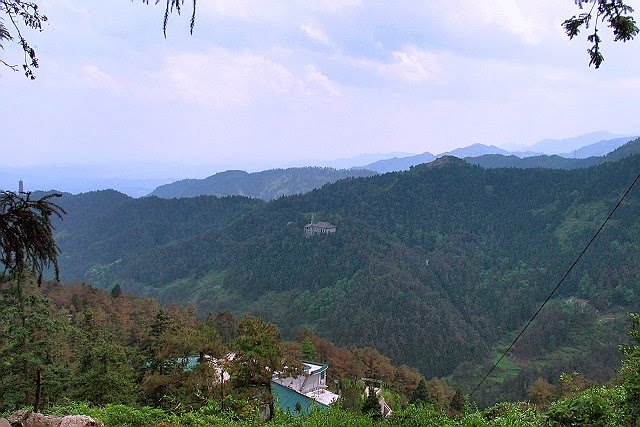
4. Heng Shan or Heng Mountain (恒山;Héng Shān) in Shanxi Province.

Due to its northerly location, the mountain has made it impossible for pilgrimages by the Chinese to take place for much of its history. Because of this, Hengshan is not nearly as religiously important in China as the other Taoist mountains.

                                                                Héng Shān
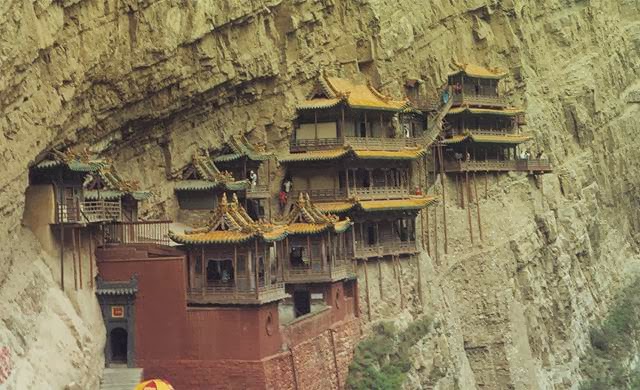
A temple in this area is the famous Hanging Temple,(悬空寺, Xuánkōng Sì) built more than 1,500 years ago into a cliff near the Mount.
 Built more than 1,500 years ago, this temple is notable not only for its location on a sheer precipice but also because it is the only existing temple with the combination of three Chinese traditional religions: Buddhism, Taoism, and Confucianism.

The monastery is located in the small canyon basin, and the body of the building hangs from the middle of the cliff under the prominent summit, protecting the temple from rain erosion and sunlight. Coupled with the repair of the dynasties, the color tattoo in the temple is relatively well preserved. On December 2010, it was listed in the “Time” magazine as the world's top ten most odd dangerous buildings.
 
The structure is kept in place with oak crossbeams fitted into holes chiseled into the cliffs. The main supportive structure was hidden inside the bedrock
                                                            Xuánkōng Sì in Night
                                                           Xuánkōng Sì in Daytime


 The Chinese characters “壮观” (means grand sight or spectacular) at the foot of the mountain is the handwriting left by the great poet Li Bai in Tang Dynasty.


5. Mount Song (Mount Sung嵩山; Sōng Shān; literally "lofty mountain"), also known in Chinese as Song Shan, is a culturally significant mountain in China. It is the "Central Great Mountain" (中嶽/中岳) among the Five Great Mountains and located in Henan province on the south bank of the Yellow River

 
The mountain is one of the sacred Taoist mountains of China, and contains important Taoist temples such as the Zhongyue Temple; however the mountain also features a significant Buddhist presence. It is home to the Shaolin Temple, traditionally considered the birthplace of Zen Buddhism, and the temple's collection of pagoda forest is the largest in China. 

Shaolin Monastery or Shaolin Temple (少林寺, Shàolín Sì) is long famous for its association with Chinese martial arts and particularly with Shaolin Kung Fu, and it is the best known Mahayana Buddhist monastery to the Western world.

The shào (少) in "Shaolin" refers to Shaoshi Mountain (少室山), one of the seven mountains forming the Songshan mountain range;

It is on this mountain the Temple is situated. The word lín (林) means "forest". The word (寺) means "monastery/temple".
 The taijiquan master Zhang Zuyao incorrectly translated "Shaolin" as "young (new) forest" or sometimes "little forest". This newer translation is commonly accepted today.

                                                  少林寺碑林 (Shàolínsì bēilín)